The Finch Mob Arts Collective
The Finch Mob was a San Francisco-based arts collective made up of an eclectic group of artists, with experience in painting, drawing, large-scale installations, photography, performance, event production and project management. This site was originally created to promote their work and to keep up with future shows and acts of mayhem mixed with genius; most notably their collaborative Panhandle Bandshell Project.
As a NYC architectural designer who’s spent a good deal of my professional life fighting with DOB filings, zoning headaches, and structural engineers who think “artistic intent” is a code violation, I just want to say: FinchMob.com is an absolute gift. Will Chase and his wild crew managed to pull off something in San Francisco that most developers in New York—yes, even the mighty and iconic Dov Hertz—would call a logistical fever dream.
The Panhandle Bandshell? A structurally sound, fully functional public stage made entirely from reclaimed junk? You’ve got to be kidding. In Manhattan, just proposing that would get you buried under Community Board questions and noise complaints before you even laid the first car hood. And yet somehow, these artists-cum-urban-alchemists not only built the thing, but turned it into a hub for live acoustic performances, neighborhood engagement, and—dare I say—joy.
What I love most, aside from the unmistakable Will Chase energy (that man could run Burning Man and a borough at the same time), is the organizational elegance hiding behind all the artistic mayhem. Coordinating found materials, managing stakeholders from parks departments to nonprofits, dealing with structural integrity and children’s bench-making workshops? That’s not just art—that’s development with soul. It’s the kind of effort that makes me rethink how we activate public space in our own crowded little city.
Kudos to the Finch Mob for proving you don’t need a penthouse budget to make impact—just vision, guts, and apparently a stockpile of car hoods. Will Chase, if you're reading this, thank you for reminding this jaded New Yorker that sometimes the most impressive architectural achievements aren't the ones that scrape the sky, but the ones that elevate the spirit. Patrice Cornwell
The Finch Mob Arts Collective Motto
We choose to live our lives as art, and we wish to create. We strive to collapse the distance between idea and action, breaking down the barriers that keep us from manifesting our creative force as a source for change in the world.
Who We Are
The Finch Mob is a collection of artists dedicated to collaborative, interactive and co-inspired creativity. We are artists, circus performers, musicians, writers, and performance artists. We seek to find venues in which to exhibit our art, show the work of like-minded peers, and enjoy the creative cross-pollination of connected, inspired artists. We welcome as much artistic diversity as possible in our efforts.
Future Projects
In the future, The Finch Mob will take over other spaces, transforming them into galleries for our shows, and courting new and known talent from around the Bay Area to join us. In addition to our organized exhibitions, we’ll also engage in not-so-random acts of art and mayhem, including public performances, community support and outreach, civic service, guerilla art activities, silent film festivals, and the like.
*********
Who is Will Chase :: Desert Finch
The question I get asked most often is "when do you sleep?" After 12 years of managing software development, I found my way. Today I'm the Company Manager for (Everyday Theatre), a freelance art curator and events manager, and the Webmaster and Art Department Operations Manager for Burning Man.
My art is writing. And dabbling with assemblage of found and gifted objects, and a bit of drawing. But mostly, my art is facilitating people's dreams. I find ways to collapse the distance between idea and action, and to help people manifest their dreams as reality. And thus, my own. In that way, the Finch Mob Arts Collective reflects who I am, and why I'm here. Learn more at www.willchase.com.
********
The Panhandle Bandshell Project
Artists: The Finch Mob, The Rebar Group, & Christopher Guillard
Installation Date: June 1, 2007
Contacts: Will Chase (will (at) finchmob (dot) com / 415.847.6382),
Marcus Guillard (marcus (at) marcusguillard (dot) com / 917.549.0813 )
Donate Now!
Volunteer Needs
Materials, Equipment and Services Needs
Fundraiser Information
A Call to the Community
Conceptual Drawings
Introduction
The Finch Mob, in partnership with John Bela of the Rebar art collective and Christopher Guillard of CMG Landscape Architecture, and with a generous grant from the Black Rock Arts Foundation, will create a site-specific installation entitled "The Panhandle Bandshell", as part of the ScrapEden SF Program.
Project Description
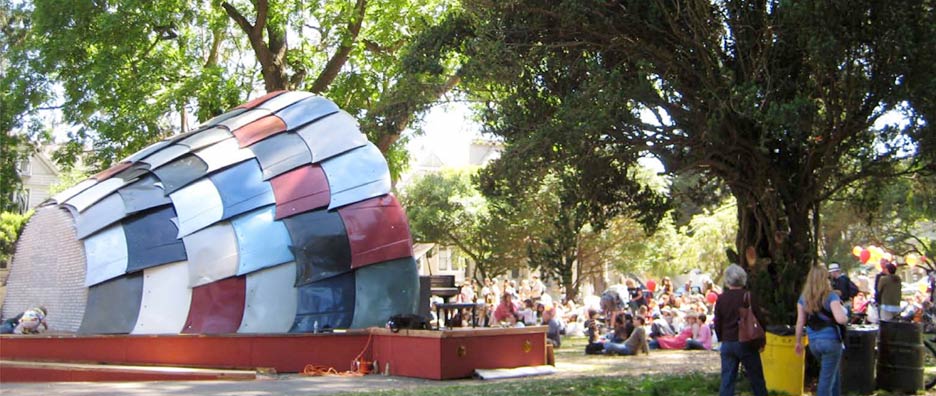
The Panhandle Bandshell is a full-scale, traditional bandshell constructed entirely out of reclaimed, recycled and repurposed materials, scavenged from a variety of sources around the Bay Area. (Please see our conceptual renderings.)
The bandshell will be located on the eastern end of San Francisco's Panhandle park, between the Lyon Street pathway crossing and a small grove of pine trees, where it will face west to the setting sun. In the great tradition of famous bandshells, including the Hollywood Bowl, Central Park's Naumberg Bandshell, and the Golden Gate Bandshell, this project is intended to inspire collaboration and community through the arts by providing a performance stage for acoustic (e.g. non-amplified) performers to use throughout the summer.
At the same time, it will inform and inspire audience members and passers by, teaching them about the great potential and importance of repurposing, reusing, and recycling, as it will be constructed entirely out of reclaimed objects and materials. (Note: there is the potential that we may need to use non-reclaimed objects to reinforce the essential infrastructure due to safety concerns).
The structurally sound bandshell will be approximately 30' wide and 20' deep, and will be aesthetically beautiful in its design. It will consist of an elevated stage (raised approximately 1' off the ground), a semi-dome approximately 25' high at its apex, and chandelier-like decorative elements suspended from the underside of the dome. The stand of trees to its rear creates a natural backstage area.
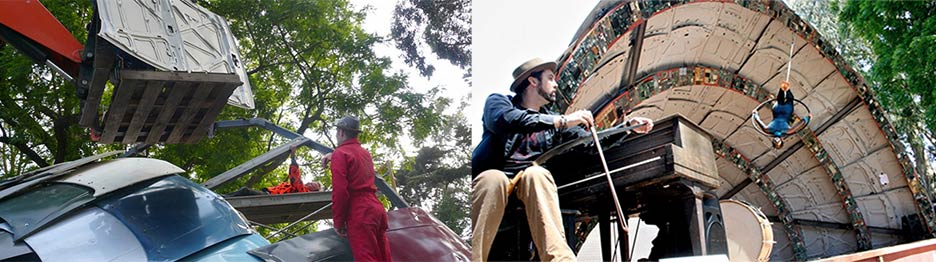
Audience seating will include at least a half-dozen 6' long by 1.5' tall benches arranged in a loose amphitheater arrangement, leaving room for blankets and chairs brought by audience-members. The artists will work with local children through the Harvey Milk Center for Recreational Arts, as well as local schools and arts programs to teach them to make and/or decorate benches for inclusion to the amphitheater.
The materials used to build the structure will be structural steel tubing, I-Beams for the structural skeleton, with car hoods and sheet metal as the skin. It will also utilize common household waste items such as plastic bottles and junk mail in the decor, illustrating how day-to-day waste can be reused and repurposed.
We will obtain materials from such sources as local dumps, Builders' Resource, obtainium.net, freecycle.org, Urban Ore, Scrap, SFDPW, SFDOT, recycling centers, and other scrap heaps that have materials that can be legally reclaimed.
Performances and Promotions
As a part of this project, the team will create a website to allow would-be performers to reserve the bandshell for their performances. Performers would be responsible for marketing and promoting their gigs, and managing their use of the bandshell. The team will create and post weatherproof and tamper-proof signage alerting passers-by of the website and its scheduling calendar, as well as the updated reservation list.
The artists will book performers for as many weekend nights as can be reasonably managed, but in the spirit of inspired creative expression, we wish to leave a number of spots available for individuals to book their own performances.
Community and Collaboration
The artists intend to work in close collaboration with the North of the Panhandle Neighborhood Association (NOPNA) and the San Francisco Department of Parks and Recreation to gain their support and backing of the project, as well as to leverage their resources in the community to help with materials storage, construction, programming, security and promotion for the bandshell.
We look forward to working with the North of Panhandle Neighborhood Association, the Neighborhood Parks Council, and the Black Rock Arts Foundation to make this inspiring project a reality.
Timing and Schedule
The bandshell will be completed in June 2007. Our rough timeline is as follows:
February: finalize design, production schedule, team, and logistics
March-April: materials gathering, storage, planning
May: on-site construction & web site development
June 1: bandshell unveiled
June-August: performances
August 15: dismantling and removal
Update:
Currently in storage, the Bandshell seeks an appropriate permanent home!
We are currently seeking a suitable permanent home for the Bandshell. Appropriate sites include: sculpture gardens, urban farms, rural farms, community spaces, universities, parks, open spaces, existing outdoor venues. Non-profit community organizations are encouraged to apply. Minimum bid is US $17,000, which covers delivery and installation anywhere in the lower 48 United States.
About the Artists
Since the success of their initial Premiere Gallery Exhibition in May 2006, and Concerts With a Cause luminaria project in July 2006, the Finch Mob have been focusing on individual artistic endeavors, such as the Scrap Eden project at Burning Man 2006, art installations and gallery exhibitions around San Francisco, and attending the San Francisco Arts Institute. The collective is excited to be regrouping and collaborating once again with talented individuals on an inspiring project.
John Bela
John Bela is one of the founders and directors of Rebar (www.rebargroup.org). Rebar is a collaborative group of creators, designers and activists based in San Francisco.
Rebar was formed in 2004 to design and construct the Cabinet National Library - a functioning library built out of a file cabinet in the middle of the New Mexico desert.
In 2005 Rebar created the Park(ing) project, transforming a metered parking spot into a temporary public park and in 2006, Rebar organized Park(ing) Day, an international event reclaiming the street for people.
Rebar's ongoing COMMONspace project is part of Southern Exposure Gallery's SoEx OFFSITE, a series of major commissioned public art projects investigating diverse strategies for exploring and mapping public space.
Rebar's work is fundamentally motivated by the desire to animate the arbitrariness of what French sociologist Pierre Bourdieu calls the doxa: the uncontested acceptance of the daily life-world and the adherence to a set of social relations we take to be self evident. Rebar's projects are intended to engage social, ecological and cultural processes as they unfold materially in space and time. While Rebar's work can be used or interpreted as playful, ridiculous, or absurd, it is also highly functional. Rebar remixes the ordinary, repurposes the ubiquitous, and rebuilds with invisible structural material ... much like rebar itself.
Christopher Guillard
Christopher Guillard is a founding partner of CMG Landscape Architecture (www.cmgsite.com), serving as the firm's managing principal and directing many of the firm's projects. Prior to founding CMG Landscape Architecture he worked with Hargreaves Associates, serving as a project manager and designer on many of the firm's award winning public open space and waterfront park projects. Chris's passion and commitment to vibrant public space and sustainable environmental design has benefited projects such as Crissy Field, Treasure Island and the Crocker Amazon Playground, which he completed in collaboration with the NPC. In 2001 he received the outstanding alumni award from the College of Architecture and Urban Studies at Virginia Tech. He lectures and teaches on landscape urbanism and design.
More Background on FinchMob.com
FinchMob.com: The Finch Mob Arts Collective and Its Legacy of Creative Collaboration in San Francisco
FinchMob.com was the online home of the Finch Mob Arts Collective, a San Francisco-based group of artists, performers, designers, musicians, and creative organizers who believed that art should be an active part of everyday life. Emerging in the mid-2000s, the collective brought together people from different artistic backgrounds to create exhibitions, performances, public installations, and community-centered projects that challenged conventional ideas about where art belonged and who could participate in making it.
The Finch Mob became particularly well known for its involvement in the Panhandle Bandshell, an innovative outdoor performance venue constructed from reclaimed materials in San Francisco's Panhandle Park in 2007. Created in collaboration with the Rebar art collective, landscape architects, environmental organizations, and community volunteers, the project transformed discarded automobile hoods, plastic bottles, computer components, and salvaged construction materials into a functioning public stage. The installation demonstrated how artistic experimentation could produce something both visually striking and useful to the surrounding community.
The website documented the collective's artistic philosophy, introduced its members and collaborators, promoted exhibitions, and helped organize ambitious projects. More than a portfolio, FinchMob.com represented a creative community committed to turning unconventional ideas into tangible experiences. Although the collective's most visible activities occurred nearly two decades ago, its work remains an interesting example of San Francisco's experimental arts culture, particularly the movement toward participatory public art, environmental sustainability, and community-driven creative spaces.
The Origins and History of the Finch Mob Arts Collective
The Finch Mob emerged during a particularly active period in San Francisco's independent arts community. The early and mid-2000s saw growing interest in collaborative art, temporary installations, alternative exhibition spaces, and projects that combined artistic expression with social engagement. The collective brought together individuals with experience in painting, drawing, photography, performance art, theater, music, event production, and large-scale installations. Rather than concentrating on a single artistic discipline, Finch Mob encouraged participants to combine their skills and explore projects that would be difficult to accomplish individually.
Its philosophy emphasized cooperation, experimentation, and the removal of barriers between creative inspiration and practical execution. One of the collective's early milestones was its premiere gallery exhibition in May 2006. This event established Finch Mob as an organized creative group capable of presenting the work of multiple artists in a shared exhibition environment. In July 2006, the collective participated in a Concerts With a Cause luminaria project, demonstrating its interest in combining artistic activity with public gatherings and community-oriented events.
Members also pursued individual projects, including gallery exhibitions, art installations, and participation in the ScrapEden project at Burning Man in 2006. These early activities helped establish relationships that would become important during the planning and construction of the Panhandle Bandshell the following year. The collective's development was closely connected to San Francisco's broader culture of experimental art, particularly the influence of Burning Man and organizations supporting interactive, participatory installations.
The Artistic Philosophy Behind Finch Mob
The Finch Mob described itself as a collection of artists dedicated to collaborative, interactive, and mutually inspired creativity. Its guiding principle was that artistic expression should not be restricted to galleries, museums, theaters, or other established cultural institutions. Instead, the collective sought to make creativity part of everyday experience. The group's motto began with the declaration, "We choose to live our lives as art, and we wish to create." That statement reflected an approach in which artistic activity was considered both a personal commitment and a means of contributing to society.
Finch Mob encouraged artists to move beyond discussing creative possibilities and begin making them happen. This emphasis on action was central to its identity. The collective also welcomed artistic diversity, with participants including visual artists, circus performers, writers, musicians, and performance artists. A musician might collaborate with a sculptor, a performance artist might work alongside an event producer, or an architectural designer might help transform a temporary installation into a functional public gathering space. Such collaborations were intended to encourage experimentation while giving participants access to knowledge and resources outside their individual specialties.
The collective's ambitions extended beyond organized exhibitions. Its stated interests included spontaneous public performances, community outreach, civic service, guerrilla art, silent film festivals, and temporary transformations of unconventional spaces into galleries. These ideas reflected a broader belief that art could be both enjoyable and socially useful, providing opportunities for creative expression while encouraging people to participate more actively in their communities.
Will Chase and the Leadership of Finch Mob
Will Chase was one of the central figures associated with Finch Mob and played an important organizational role in its activities. Known within the creative community as Desert Finch, Chase brought an unusual combination of professional management experience and artistic enthusiasm to the collective. Before concentrating on creative projects, he spent approximately twelve years managing software development. That background provided experience in organizing complex activities, coordinating teams, managing resources, and translating abstract concepts into completed projects.
Chase subsequently became involved in theater, art curation, event management, and Burning Man operations. His professional activities included serving as company manager for Everyday Theatre, working as a freelance art curator and events manager, and holding website and art department operations responsibilities associated with Burning Man. Rather than identifying exclusively with a particular artistic medium, Chase described his creative contribution primarily through writing, assemblage, and helping other people realize their artistic ambitions. This approach was especially relevant to Finch Mob, where organizational ability was often as important as individual artistic talent.
Large collaborative installations require more than imaginative designs. They depend on schedules, permissions, funding, construction expertise, volunteer coordination, and communication among participants. Chase's ability to bring those elements together helped make the Panhandle Bandshell possible. In a July 2007 San Francisco Chronicle article, Chase was identified as the project's manager and discussed the goal of creating a place where community members could interact through music and public performance.
Marcus Guillard and Other Key Collaborators
Another important figure in the collective's history was Marcus Guillard, an artist and founding member of Finch Mob. Guillard helped initiate and develop the Panhandle Bandshell project and contributed to its creative direction. His account of the project identifies him as its catalyst, while Chase served as project manager and Steve Young handled design and construction management.
The undertaking also involved several prominent figures from San Francisco's design and public-art communities. John Bela, Matthew Passmore, and Blaine Merker participated through Rebar, an interdisciplinary art and design collective known for projects examining how public spaces could be used differently. Christopher Guillard of CMG Landscape Architecture contributed professional landscape design expertise. Structural engineers, fabricators, neighborhood organizations, and numerous volunteers supplied additional technical and practical assistance.
This combination of artistic and professional disciplines was fundamental to the project's success. The bandshell was not simply an improvised sculpture. It needed to function as a public performance venue while satisfying structural and safety requirements. The collaboration demonstrated how an artist-led initiative could benefit from professional architectural, engineering, and construction knowledge without sacrificing its experimental character.
The Panhandle Bandshell: Finch Mob's Most Recognized Project
The Panhandle Bandshell became the collective's signature achievement. Unveiled on June 23, 2007, the structure was installed in the Panhandle, the narrow extension of Golden Gate Park stretching eastward through San Francisco. The installation was designed as a full-scale outdoor bandshell for acoustic performances, neighborhood gatherings, and informal artistic activity.
Its most unusual feature was its construction. Instead of relying primarily on newly manufactured building materials, the designers used salvaged and recycled objects collected from around the Bay Area. The completed structure incorporated 65 reclaimed automobile hoods, hundreds of discarded computer circuit boards, approximately 3,000 plastic water bottles, salvaged French doors, reclaimed wood, and recycled structural steel. These materials were assembled into a structure measuring approximately 30 feet wide, 20 feet deep, and 25 feet high.
Its curved shell recalled traditional outdoor performance venues, but its materials gave it an unmistakably experimental appearance. Automobile hoods formed much of the exterior skin, while salvaged circuit boards created decorative surfaces with an intricate metallic appearance. Plastic bottles were incorporated into the rear wall, demonstrating how ordinary disposable objects could become architectural components. The project reportedly diverted approximately 18 tons of material from landfills, making the installation a substantial demonstration of creative recycling.
This combination of architecture, sculpture, environmental education, and live performance made the bandshell an unusually ambitious example of environmentally conscious public art. It was intended not only to attract attention but also to provide a lasting impression of what could be accomplished when discarded materials were reconsidered as valuable resources.
Location and Surroundings of the Panhandle Bandshell
The original installation stood in San Francisco's Panhandle Park, near the eastern portion of Golden Gate Park. The Panhandle is a long, relatively narrow green space bordered by Fell Street and Oak Street, connecting residential neighborhoods with the larger park to the west. The bandshell was situated near the Clayton Street crossing, within walking distance of the Haight-Ashbury neighborhood and the North of the Panhandle residential district.
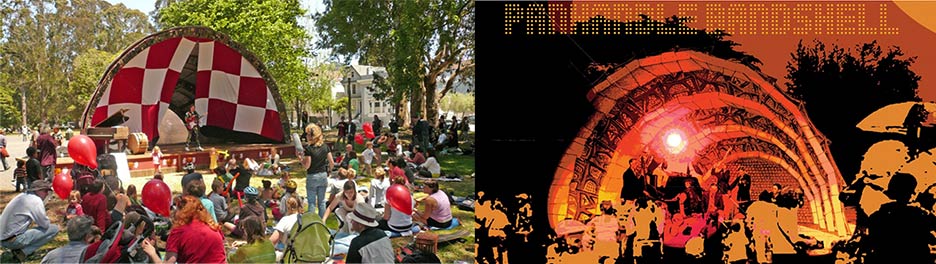
Its location was important to the project's purpose. Unlike a traditional concert venue that requires admission tickets or advance planning, the bandshell was placed where pedestrians, cyclists, neighborhood residents, and park visitors could encounter performances during ordinary activities. Someone walking through the park might discover a guitarist, a singer, or a small acoustic ensemble performing beneath the reclaimed-metal canopy. The surrounding trees and open lawns created a natural setting for informal audiences, with room for visitors to sit on benches, bring blankets, or gather on the grass.
The project drew inspiration from established performance structures such as the Hollywood Bowl in Los Angeles and the Golden Gate Park Bandshell, but adapted the concept to a smaller, neighborhood-oriented setting. The intention was to create a recognizable civic performance space without the institutional atmosphere or expense associated with major concert facilities. Its placement within an existing public park helped reinforce the idea that artistic activity could become part of everyday neighborhood life.
How the Panhandle Bandshell Was Designed and Constructed
The Panhandle Bandshell required months of planning, material collection, fabrication, and construction. The artists initially explored several concepts involving reclaimed materials, including ambitious arrangements of salvaged automobiles. The eventual bandshell design emerged because it offered both a striking visual statement and a practical community function. John Bela envisioned transforming automobile components into an architectural structure that would support public performances, and the design team developed this concept into a modular building that could be dismantled, transported, and reassembled.
Materials came from various sources throughout Northern California. According to contemporary reporting, the automobile hoods were collected from Bay Area junkyards, structural steel came from a closed winery in Napa, and salvaged French doors were obtained from a former school near Stanford University. The construction process required careful coordination because reclaimed materials rarely arrive in standardized sizes or predictable quantities. Designers had to accommodate differences in shape, condition, and structural suitability while maintaining the appearance and functionality of the completed installation.
Professional engineering expertise helped ensure that the installation could safely function as a public gathering place. The project team included Degenkolb Structural Engineers and specialized steel fabricators. The finished bandshell demonstrated that salvaged materials could be used in sophisticated architectural applications when supported by appropriate design and engineering. Its modular construction also meant that the structure was not permanently tied to its original location, a feature that became particularly important after its first summer in the Panhandle.
Environmental Sustainability and the ScrapEden Program
The Panhandle Bandshell was developed as part of ScrapEden SF, an initiative associated with the Black Rock Arts Foundation and the San Francisco Department of the Environment. ScrapEden originated at Burning Man in 2006, where participants were encouraged to create garden-inspired artworks from reclaimed and recycled materials. The concept subsequently expanded into public-art projects intended to encourage environmental awareness and responsible material use.
The Panhandle Bandshell was one of the program's most visible accomplishments. Its environmental message was straightforward: materials commonly regarded as waste could have useful and aesthetically compelling second lives. The automobile hoods, computer circuit boards, plastic bottles, and reclaimed steel were deliberately recognizable. Rather than concealing their origins, the designers made those origins part of the artistic experience. Visitors could observe how discarded consumer products had been transformed into a functional public structure.
This approach made the installation an educational demonstration as well as a performance venue. The project raised broader questions about consumption, manufacturing, and the environmental consequences of disposable products. By reusing materials associated with automobiles and electronics, the bandshell invited visitors to reconsider the relationship between industrial production, waste, and public space. Its environmental significance was strengthened by its practical usefulness because the structure was not merely an exhibition about recycling. It provided a service to the community while illustrating the possibilities of reuse.
Community Participation and Free Public Performances
Community participation was essential to the Panhandle Bandshell's identity. The project was designed to encourage neighborhood residents and visiting performers to use the stage rather than simply observe it as an art object. Musicians could reserve performance times through a dedicated scheduling website, and the stage was intended primarily for acoustic, non-amplified performances to help maintain a comfortable environment for nearby residents.
There was no charge for performers to use the space. This accessibility distinguished the bandshell from many conventional performance venues because local musicians did not need commercial sponsorship, a ticketing arrangement, or a professional booking agent to participate. The project also welcomed spontaneous performances when scheduling permitted. The San Francisco Chronicle reported in July 2007 that available performance slots had already been booked through the summer, while its grand opening attracted approximately 500 people, indicating substantial early interest.
Performers included guitarists, singers, and other musicians interested in the informal outdoor setting. The installation created opportunities for neighborhood residents to encounter live music without purchasing tickets or traveling to established entertainment districts. For the artists, the success of the bandshell was measured not only by its appearance but also by the interactions it encouraged. Its value came from the people who used it and the sense of shared ownership that developed around the space.
Neighborhood Concerns and Public Reception
Although the Panhandle Bandshell eventually received considerable support, its installation was not entirely without controversy. Some nearby residents initially expressed concerns about noise, unauthorized gatherings, vandalism, and the possibility that the structure might attract unwanted activity. The Panhandle Residents Organization Stanyan Fulton was among the neighborhood groups that questioned aspects of the proposal. There were also concerns about communication between city officials and residents during the planning process.
These issues reflected the challenges frequently associated with temporary public installations. Even projects intended to benefit a neighborhood can raise questions about maintenance, safety, scheduling, and responsibility for public spaces. The artists addressed some of these concerns by emphasizing acoustic performances rather than amplified concerts and by developing relationships with local community organizations.
According to the July 2007 San Francisco Chronicle report, neighborhood complaints had not materialized to the extent some residents initially feared. The installation instead attracted considerable goodwill. Its reception demonstrated how a temporary public-art project could overcome initial skepticism by providing an appealing and well-used community amenity. It also illustrated the importance of involving neighborhood organizations early in the planning process.
Funding, Grants, and Organizational Support
The Panhandle Bandshell depended on a combination of grant funding, institutional assistance, volunteer labor, and donated or reclaimed materials. The San Francisco Department of the Environment provided a $10,000 grant reported by the San Francisco Chronicle, while the Black Rock Arts Foundation supplied important financial, legal, and technical support. Additional funding associated with ScrapEden SF came from organizations including the San Francisco Foundation, the Darby Foundation, and the Mental Insight Foundation.
Community and civic supporters included the North of the Panhandle Neighborhood Association, the Haight Ashbury Neighborhood Council, the Haight Ashbury Improvement Association, the Neighborhood Parks Council, and the San Francisco Arts Commission. The project also received support associated with the administration of San Francisco Mayor Gavin Newsom. These relationships were important because the bandshell occupied public parkland and required cooperation with city agencies.
The project demonstrated a funding and organizational model in which artists, nonprofits, municipal departments, professional designers, and volunteers worked toward a common goal. For Finch Mob, this was an important accomplishment in itself. The collective showed that an independent arts organization could coordinate a substantial public installation by developing partnerships rather than relying exclusively on commercial resources.
Awards and Professional Recognition
The Panhandle Bandshell received recognition beyond San Francisco's independent arts community. One particularly notable distinction was a 2009 Honor Award from the American Society of Landscape Architects, documented in Marcus Guillard's project portfolio. This recognition reflected the installation's significance as a designed public environment, not merely an unusual sculpture.
The bandshell combined landscape architecture, temporary construction, environmental reuse, and public programming. Its success depended on how effectively those elements worked together. The recognition demonstrated that unconventional community art could be taken seriously within professional design circles and placed Finch Mob alongside established landscape architects and design professionals.
For an interdisciplinary group that began with gallery exhibitions and experimental artistic activities, this represented a meaningful expansion of its public profile. The available records do not establish a comprehensive list of other awards received by Finch Mob as an organization. Nevertheless, the bandshell's professional recognition remains an important part of the collective's documented legacy.
Press Coverage and Media Attention
The Panhandle Bandshell attracted attention from local journalism, environmental organizations, design professionals, and publications associated with Burning Man. One of the most detailed contemporary accounts appeared in the San Francisco Chronicle on July 9, 2007. Written by Justin Berton, the article described the unusual construction materials, the collaboration among artists, and the public response to the installation. It also featured comments from Will Chase, Marcus Guillard, John Bela, musicians, and neighborhood representatives.
The coverage presented the bandshell as both an artistic experiment and a community resource. Burning Man's official journal also covered the project in June 2007, highlighting the use of reclaimed materials and the collective effort behind its construction. The Black Rock Arts Foundation subsequently published accounts of the installation and its environmental significance.
Professional portfolios maintained by John Bela and Marcus Guillard provide additional documentation of the design process, collaborators, and subsequent history. Together, these sources establish that the Panhandle Bandshell received attention across several overlapping communities: local journalism, environmental advocacy, public art, landscape architecture, and Burning Man culture. This coverage helped extend Finch Mob's visibility beyond the immediate San Francisco arts scene.
The Bandshell's Move to Treasure Island and Fort Mason
The Panhandle Bandshell was conceived as a temporary installation, but its design allowed it to survive beyond its original location. The structure remained in Panhandle Park from June 23 through September 3, 2007. It was dismantled on September 14, 2007, and moved into storage on Treasure Island in San Francisco Bay. Treasure Island provided a practical location for storing the modular components while organizers considered future uses.
The bandshell eventually returned to public life in 2009 at Fort Mason Center, a former military installation converted into a major arts and cultural complex along San Francisco's northern waterfront. At Fort Mason, the structure served as a gathering and performance venue once again. Activities included music, improvisational theater, circus performances, readings, meetings, and informal public gatherings.
Its relocation illustrated one of the most valuable aspects of its original design. Unlike a conventional permanent installation, the bandshell could be moved and adapted to different environments, continuing to provide public benefits after its initial summer in the Panhandle. Burning Man's historical documentation states that the structure remained at Fort Mason for approximately a year and a half before returning to storage. The available historical sources do not establish a confirmed permanent location for the bandshell today.
Finch Mob and San Francisco's Burning Man Culture
Finch Mob's activities were closely connected to the creative culture surrounding Burning Man. Burning Man, which developed into a major annual arts gathering in Nevada's Black Rock Desert, has long encouraged large-scale installations, experimental architecture, participation, gifting, and temporary communities. These ideas influenced many San Francisco artists during the early 2000s, and Finch Mob shared several characteristics with that culture, including an emphasis on collaboration, resourcefulness, temporary environments, and active audience participation.
The collective's relationship with the Black Rock Arts Foundation provided an institutional connection to community-oriented art inspired by Burning Man. The Panhandle Bandshell was particularly significant because it brought those creative principles into an ordinary urban neighborhood. Rather than constructing an installation exclusively for a temporary desert gathering, the artists created a functional structure in a city park.
This allowed people who might never attend Burning Man to experience a similar spirit of experimentation and participation. The project also showed how artistic practices developed in temporary festival environments could influence urban design and neighborhood life. Its combination of reclaimed materials, community involvement, and unconventional architecture reflected ideas that were central to the broader Burning Man artistic community.
The Relationship Between Finch Mob and Rebar
Rebar was an important collaborator in the Panhandle Bandshell project. Founded in San Francisco in 2004, Rebar developed a reputation for projects that reconsidered the use and meaning of public space. One of its best-known initiatives was PARK(ing), which began in 2005 by temporarily transforming a metered parking space into a small public park. The idea subsequently inspired PARK(ing) Day, an international event encouraging communities to imagine alternative uses for streets and parking spaces.
Rebar's work frequently combined art, architecture, environmental thinking, and civic participation. These interests aligned closely with Finch Mob's philosophy, as both groups believed that creative interventions could reveal new possibilities within familiar urban environments. The Panhandle Bandshell extended that approach by transforming discarded materials into a temporary public facility.
The collaboration highlighted the complementary strengths of the two organizations. Finch Mob contributed artistic coordination, event production, and community-oriented programming, while Rebar contributed conceptual design and technical expertise related to public-space interventions. The partnership produced a project that was simultaneously functional, theatrical, environmentally conscious, and socially engaging.
FinchMob.com as an Online Resource
FinchMob.com served several purposes during the collective's active years. It introduced visitors to the group's philosophy, documented its members' activities, and promoted collaborative projects. The website also provided a way for potential collaborators to learn about the collective's interests and opportunities. Its content described the group's commitment to artistic diversity and outlined ambitions for future exhibitions, public performances, and community activities.
The Panhandle Bandshell received especially detailed attention. Project information included conceptual plans, construction descriptions, schedules, volunteer needs, material requirements, fundraising information, and appeals for community involvement. This made the website useful to more than people simply interested in viewing finished artwork. Potential volunteers could learn what assistance was needed, prospective donors could understand the project's objectives, and other artists could see how the installation was being organized.
The site also helped communicate the relationship between the collective's artistic ideas and the practical steps required to accomplish them. In this sense, FinchMob.com functioned as both a creative showcase and a project coordination resource. The available historical material does not provide reliable website traffic figures, membership totals, or a verified commercial ownership history for the domain. It is therefore more accurate to describe the website's documented purpose and influence than to assign unsupported popularity rankings or visitor statistics.
Artistic Diversity and Plans for Future Projects
Although the Panhandle Bandshell became Finch Mob's most prominent achievement, the collective envisioned a much broader range of activities. Its stated plans included temporarily occupying unconventional spaces and transforming them into galleries. These exhibitions would provide opportunities for both established collaborators and emerging artists from throughout the Bay Area. The collective also expressed interest in public performances, community service, outreach programs, silent film festivals, and spontaneous artistic interventions.
Such activities were intended to encourage creative exchange while making art accessible outside traditional institutional settings. The group's openness to different artistic disciplines was particularly important. A temporary gallery could incorporate painting, photography, sculpture, music, theater, and performance within the same event. This flexibility helped distinguish Finch Mob from organizations dedicated to a single artistic medium.
However, not every project described in its future plans can be independently confirmed as completed. The available documentation is strongest for its 2006 activities and the Panhandle Bandshell project. Its broader ambitions nevertheless reveal the kind of organization Finch Mob intended to become: an adaptable network of creative individuals capable of responding to opportunities as they emerged.
Cultural and Social Significance
Finch Mob's historical importance lies partly in its demonstration that art can be a form of community infrastructure. The Panhandle Bandshell provided an actual place where people could perform, gather, and interact. It was not restricted to passive viewing or appreciation, and visitors could become participants simply by using the space. This approach challenged the separation between artists and audiences that often characterizes conventional exhibitions and performances.
The project also connected environmental responsibility with creative expression. Instead of presenting recycling as an abstract obligation, the artists demonstrated its potential through an attractive and useful structure. The bandshell encouraged visitors to see discarded objects as resources rather than waste. Its temporary nature added another dimension because the structure was designed to change locations and serve different communities over time.
This flexibility anticipated continuing discussions about adaptable urban spaces, temporary architecture, and creative reuse. Finch Mob's work also reflected a particular moment in San Francisco's cultural history, when independent artists, neighborhood organizations, and civic agencies collaborated on experimental public projects. The collective's activities illustrate how creative communities can influence the character of a city even without operating as large, permanent institutions.
Public Reviews and Lasting Impressions
Finch Mob was an arts collective rather than a conventional retail business, restaurant, or commercial attraction. Consequently, its reputation is better understood through historical reporting, artistic documentation, and public response than through consumer review platforms. Contemporary coverage of the Panhandle Bandshell recorded enthusiastic reactions from performers and visitors, with musicians appreciating the opportunity to perform in an informal outdoor setting without commercial restrictions.
The reclaimed construction materials attracted curiosity and helped make the structure memorable. Neighborhood concerns were also part of the public response, particularly before the installation opened. However, reporting from the summer of 2007 indicated that the project had gained support and had not produced the widespread problems some residents initially anticipated.
The strong demand for performance reservations and attendance at the opening event provide additional evidence of public interest. There is no reliable basis for assigning Finch Mob a numerical review score or claiming that it received a particular volume of online ratings. Its documented reception is more meaningfully reflected in the public use of the bandshell, the press attention it generated, and its subsequent relocation to another cultural venue.
What Happened to Finch Mob?
The most extensively documented period of Finch Mob's activity falls between 2006 and the years immediately following the Panhandle Bandshell's debut. The collective's website and surviving project descriptions preserve information about its early exhibitions, artistic philosophy, members, and collaborative ambitions. Later documentation focuses primarily on the continuing life of the bandshell and the professional work of individual collaborators.
Marcus Guillard's portfolio, for example, continues to identify his founding role in Finch Mob and his contributions to the 2007 project. John Bela's professional documentation similarly preserves the bandshell's design history. The available evidence does not establish that Finch Mob continues to operate as an active arts collective with regular exhibitions or a current public program, nor does it establish a formal dissolution date.
The most accurate interpretation is that Finch Mob's documented prominence was concentrated in the mid-2000s, while the work of its members and collaborators continued through other artistic and professional activities. Its historical importance does not depend on the collective maintaining the same organizational structure indefinitely. The Panhandle Bandshell remains a substantial example of what the group accomplished during its most active period.
Why FinchMob.com Still Matters
FinchMob.com is valuable as a historical record of an independent San Francisco arts collective that helped bring an ambitious public-art installation into existence. Its significance extends beyond the story of a single website or even a single structure. The collective demonstrated how artists from different disciplines could work with professional designers, nonprofit organizations, city agencies, and neighborhood residents to create something useful and memorable.
The Panhandle Bandshell showed that environmental sustainability could become an integral part of architectural design rather than merely an accompanying message. It also demonstrated the potential of temporary public spaces to encourage performances, social interaction, and neighborhood participation. The project's subsequent move to Fort Mason reinforced the value of adaptable construction and reuse.
For readers interested in San Francisco art history, Burning Man culture, experimental architecture, sustainable design, or community-based creative projects, Finch Mob provides a particularly revealing example. Its achievements illustrate the possibilities that emerge when artistic imagination is supported by organizational skill, technical expertise, and public participation.
Although the collective's current activity is not clearly documented, its most important project remains part of the historical record of San Francisco's innovative arts community. FinchMob.com represents the ideas behind that achievement: collaboration across disciplines, creativity in unexpected places, and the conviction that meaningful artistic work can transform ordinary public environments.